

Take control of your emotions
The world will not calm down.
But you can become someone who remains steady within it.
In a world that constantly provokes us, our emotional distress disempowers us on two fronts simultaneously:





Our triggers control our emotional state





Our coping mechanisms control our autonomy
Nothing controls my feelings or actions. I cannot be destabilized. I am free.
Emotional fitness is when you can say:
When we are emotionally fit, we can face life’s challenges with:
Serenity
Positivity
Adaptability
Vitality
Resiliency
Upcoming Events
Learn more about our in-person and online emotional fitness outreach programming.

Our goal is to make people triggerproof.
The core test of emotional fitness is how we handle life’s challenges such as rejection, failure, change, death, poverty, and loss.
When we are emotionally fit, we can confront those situations and respond positively – in a constructive, optimistic, and empowered way.
What we do
At Vivir, we teach our proprietary, clinically-developed emotional fitness practice for taking control of one’s emotional system called:
REIU– Rational-Emotional Integrative Updating
REIU is a 15-minute/day emotional fitness practice that aligns the rational and emotional systems by updating both how one thinks and how one feels.
It is powered by Emotional Updating, an unconscious mental technique to untrigger the post-traumatic emotional responses that hijack our emotional systems.
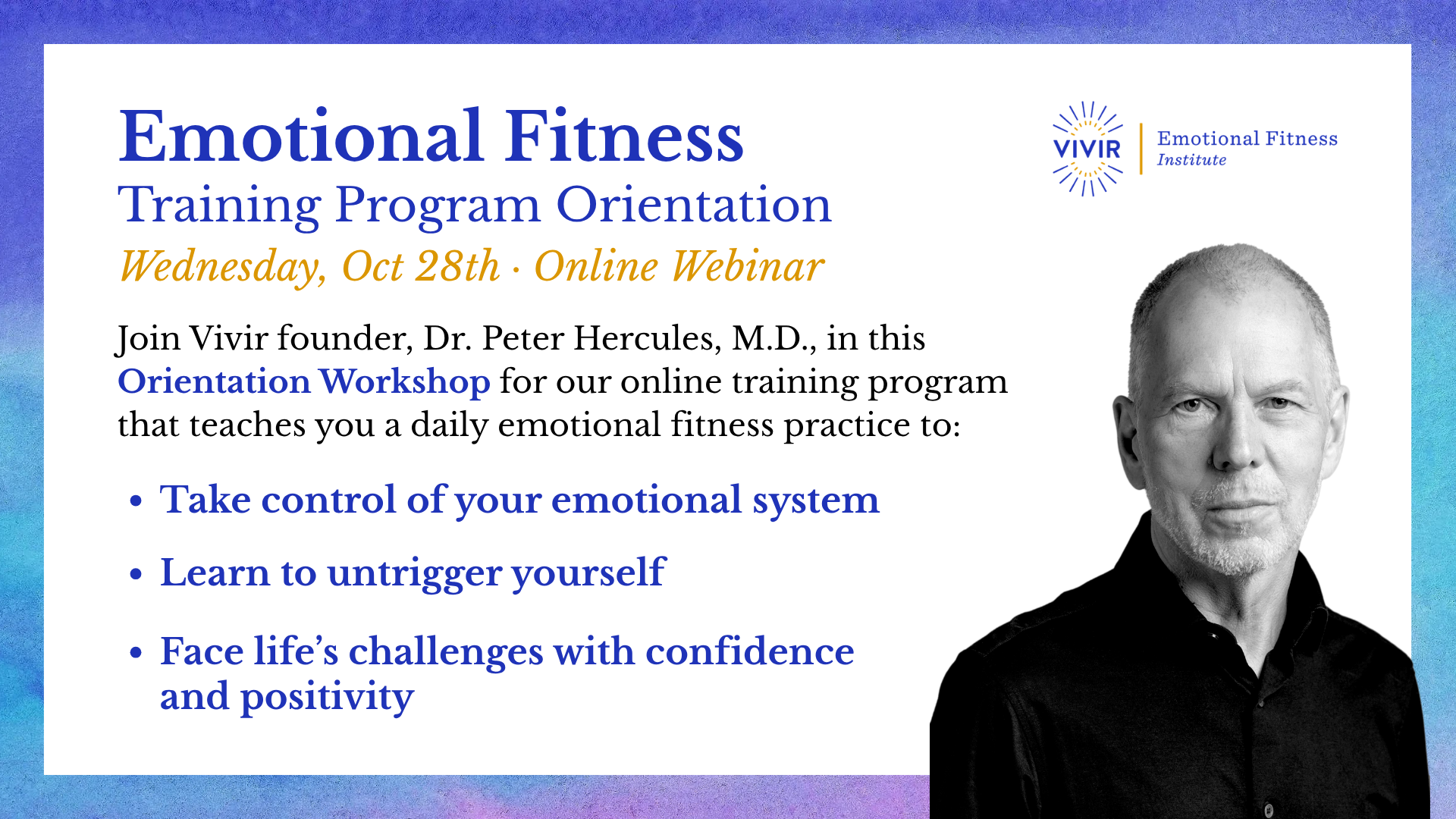
Vivir founder, Dr. Peter Hercules, M.D., explains the importance of Emotional Fitness in this time of great emotional suffering.

REIU Training Program
An online training program for learning the REIU Emotional Fitness practice
Working directly with our founder, Dr. Peter Hercules, and our trained support staff, this emotional fitness training program helps you build the skills and habits to take control of your emotional system through live one-on-one sessions, group sessions, and an online curriculum.

Our Founder
Dr. Peter Hercules, M.D.
Dr. Hercules is a board-certified physician with more than 40 years of clinical experience in the US and Canada, specializing in emotional system dysfunction.
Over the past 30+ years, he developed the REIU program and the Emotional Updating technique, which he has used to help countless people address a wide range of emotional and behavioral challenges.

-
Untrigger Yourself Podcast
A bi-weekly podcast by Vivir founders Dr. Peter Hercules and his daughter, Katrina Hercules.
The podcast offers insights, stories, and reflections that uncover the immense potential for personal growth, well-being, and emotional fitness that lie beyond our triggered responses.
-
Emotional Fitness Articles
Explore our library of articles that delve into many important facets of emotional fitness.
This knowledge base is a resource for anyone interested in developing a deeper appreciation of how and why prioritizing emotional fitness is so essential for overall well-being.
Our Methodology
-
Emotional fitness is the ability to consistently confront reality and respond to it positively – in the most constructive, optimistic, and empowered way that one possibly could.
Emotional distress – whether fear, anger, sadness, shame, or guilt – undermines our ability to handle situations in the most effective way possible. As we develop our capacity to deal with reality consistently and positively, we can then optimally face the challenges of our personal and larger lives.
We feel at home in the world and fundamentally good being whoever we are, and ultimately experience life with more vitality, positivity, adaptability, resiliency, and serenity.
-
At Vivir, we teach our students REIU – Rational-Emotional Integrative Updating.
Developed by Dr. Hercules, this emotional fitness practice is a structured daily discipline for aligning the rational and emotional systems by updating both how one thinks and how one feels.
REIU works in three phases:
Rational - Update thinking by identifying problematic thoughts and emotional responses, and choosing to change them.
Emotional - Update feelings by changing the triggered emotional responses connected to that pattern using the Emotional Updating technique.
Integration - When the rational and emotional systems are updated, both sides now operate in sync.
This process is applied iteratively wherever misalignment between the rational and emotional systems appears.
-
Anyone who has emotional responses that they want to change is a good candidate for REIU.
We are seeing a greater number of people being incapacitated due to stress and the emotional reactions they have to the realities of life. The good news is we can do something about this. We can actually empower ourselves.
-
A triggered response is a collection of feelings activated by a stimulus – such as a person, place, comment, or tone of voice.
Triggered responses develop due to traumatic experiences. It's a protective mechanism formed automatically in an attempt to avoid being retraumatized.
We come with a built-in ability to develop triggered responses, and we do so unconsciously. A triggered response is basically the best protective strategy the unconscious mind could come up with at the time of a traumatic event.
When we’re triggered, we're transported out of present reality and back into the emotional state of the original traumatic event. This involves the limbic system — the emotion center of the brain. During a triggered response the prefrontal cortex, the reason and logic part of our brain, is offline.
-
Our triggered emotional responses were formed for who we were in that traumatic situation, at that time. And when we’re triggered, we react as if nothing has changed from that original event.
But apart from the trigger itself, the situation may be radically different and we typically possess knowledge, wisdom, perspective, understanding, and power that we did not have then. Reacting to a present-day trigger as if we’re still that person, in that situation, with those limited resources is, by definition, out of date.
Unfortunately, out-of-date triggered responses don't fade with time. They typically intensify. Fortunately, they can be changed.
Because triggered emotional responses are created and operate unconsciously, we need an unconscious method to untrigger ourselves. Emotional Updating is the unconscious mental technique we teach to do just that.
-
Emotional Updating is an unconscious mental technique for untriggering outdated post-traumatic emotional responses at their root.
While we all have the built-in mechanism to create triggered emotional responses, we do not have a built-in mechanism to update them – it’s a skill that must be learned.
With Emotional Updating, a facilitator — either a trained Vivir practitioner or the Vivir app — guides you into a relaxed state and establishes communication with the unconscious mind through ideomotor signals like finger movements.
From there, a standardized series of Yes/No questions directs the unconscious mind to:
Identify the outdated emotional response and trace it back to the original traumatic experience.
Review that experience to understand the feelings and the reasons behind them.
Apply your current resources and understanding to address those feelings.
Update the response by deleting old feelings that are no longer necessary for protection.
Revisit the experience to confirm the feelings have been updated.
The updated response then becomes the new, automatic reaction to the trigger.
Once you know how to change a response with Emotional Updating, you can change any response, any time, for the rest of your life.
-
If we have lots of out-of-date responses being triggered, maintaining emotional stability is very difficult because people in pain make fundamentally different decisions than people who aren't in pain.
When we avoid what triggers us, we don't actually manage our discomfort — we shrink our world. And the longer we avoid, the more intimidating the avoided thing becomes, and the harder it is to face.
When we can’t avoid our triggers, we suffer due to the emotional distress they cause, and we lose control of our emotional system to whomever or whatever it is that triggers us.
Finally, the coping mechanisms we employ to manage our emotional distress limit our personal autonomy. A coping mechanism is essentially a pain pill.
So if we rely on options like substances or distractions to handle our distress, we are essentially a hostage to that pain management solution. And whatever the underlying issue is, it's typically getting worse in the meantime.
What's required is actual healing — not management strategies applied over a broken foundation, but genuine reconstruction of the foundation itself.
-
Our basic objective is that we want people to be able to experience life’s challenges like failure, rejection, loss, and injustice and still feel emotionally stable and okay within and about themselves.
When something triggers us, it is poking a wound we've been carrying around since long before that moment. The intensity of our reaction has less to do with what just happened than with how deep the wound already is.
Becoming triggerproof is about healing the wounds so there's nothing left to poke.
-
REIU is a habitual daily practice meant to integrate into our life, much like a dental hygiene habit of brushing our teeth every day. It is the on-going maintenance required to keep our emotional system healthy and strong.
Just as with dental health, if we want to optimize our emotional well-being, it's something we should maintain indefinitely.
Motivation waxes and wanes. It's not a reliable foundation for change. What actually works is a structured, disciplined daily habit: a practice we return to regardless of how we feel that day. Once a habit is deeply ingrained, it has a power of its own that carries us through the days when motivation has gone missing.
-
Almost no one has a ‘hardware’ problem – that is, an inherent structural disorder of their brain. All of these conditions are ‘software’ problems – post-traumatic responses to dysfunctional environments.
The hardware is good. The software is out of date. If you update the software, you effectively morph into a different version of yourself.
A diagnosis can offer information, perspective, the reassurance that you're not alone, and sometimes useful coping strategies. What it almost never does is actually change a triggered response. Understanding why you react the way you do is not the same as changing how you react.
Our approach is to change the software. You don’t have write off the whole computer.
We all have this potential. We can all grow. We can all change.
-
Managing emotional distress is not the same thing as not having it.
If you have a triggered response and you're exposed to its trigger, the response will be activated — whether you understand it, whether you've read extensively about it, whether you've been in therapy for years, whether you use pharmaceuticals or psychedelics to diminish the acute distress.
It doesn't fade on its own. You may be managing it, but the pain remains unless you've done something to address the underlying cause.
One of the clear advantages of the REIU program with the Emotional Updating technique is that you actually change the triggered response. Once you've done that, you don't have to manage anything — your automatic response to the trigger will simply be different.
This is also an empowering methodology people can learn in a reasonably short period of time and then apply independently on an ongoing basis, without therapists or pharmacological products. Once you understand the approach and apply it consistently, you can do almost all the work on your own.